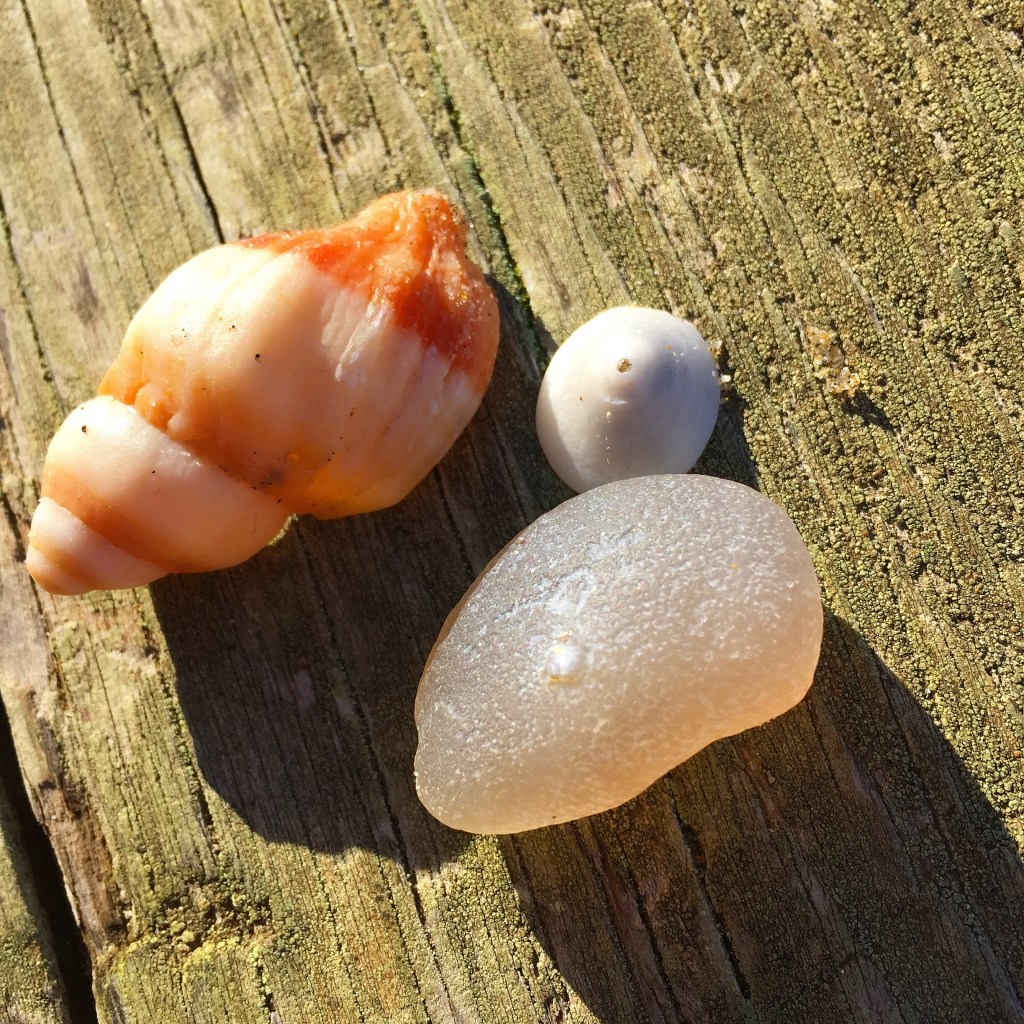
The two are almost inseparable. That is—living at the Coast and prowling along the beach looking for treasures. And, if you are diligent and keep your head down, the ocean does not disappoint. There are shells of every shape and size, some rarer than others. The veteran beachcomber doesn’t deign to stoop for the everyday clam and mussel shells, which is not to say they aren’t appreciated. But what a joy to spy a new shape, a white whelk or limpet to add to your already brimming collection, covering all available spaces at home. The sand stars—or sand dollars, as they are more commonly known—are everywhere to be had. The kids love them, especially the tiny ones. Perhaps most prized among beach gatherers are colorful buoys that have broken away from fishing vessels from far and near. Walk around our little community and you’ll see buoys of every color, shape and size adorning porches and gardens. Our favorite landscaping decor. And then there are the rare finds: bottles that have floated in the Pacific for months and years, some with foreign language markings; clear and still unbroken lightbulbs, often from Japan or China. My daughter and I once had a rather extensive collection of these, left behind in some long ago move. The old-timers here report even more unique and interesting finds—a wooden Buddha statue, an iron lung, a tin whistle. “Beachcombing is not what it used to be,” they say. “Too many tourists. Nothing left to find.” I beg to disagree, but understand the sentiment.
My own history as a serious beachcomber began, oddly some might say, in New Jersey—the Jersey Shore as we call it. Some people disparage the Jersey Shore, stereotype it as nothing more than packed beaches and salt-water taffy. But that was not the case, back when my family began spending summers on Long Beach Island in the mid-fifties. The sand was white and clean then, and kids could wander through endless dunes and drop crab lines in the bay. It’s different now, I admit. Over-crowding and overbuilding changed the landscape. But that’s a story for another day.
My mother introduced me to beachcombing. She would walk the beach every day during low tide, when the Atlantic would offer up its prizes. Mom had a particular focus for her searches. She was after beach glass—those colorful shards weathered and smoothed by the waves and time. We had many full bottles of them decorating our little cottage. Mom pointed out that if you wanted to find the good pieces you had to walk with your head down and pay attention. That was hard for me to do, jittery kid that I was, always ready to run and dive into the surf as Mom plodded carefully along, filling her pockets with red, green, even white pieces of smooth, striated glass, which she would hold out for me to admire when I rejoined her.
After I left home and New Jersey, there was a long period where I lost touch with beachcombing and surfing. Some of those years were sadly in-land, away from either coast. When I came to my senses and realized I wanted to again live by the sea, I moved my family west and found my way eventually to the Pacific Coast, and back to walking head down along the beautiful and uncrowded beaches of Oregon and Washington. It was then that I told myself I was a committed Beach Bum (I’ve even written a book of that name) and would stay that way till I could no longer breathe. Even then, as I’ve told my family, scatter my ashes on the beach and in the Ocean. Do it early though, don’t want to upset the combers and the surfers.


Leave a Reply