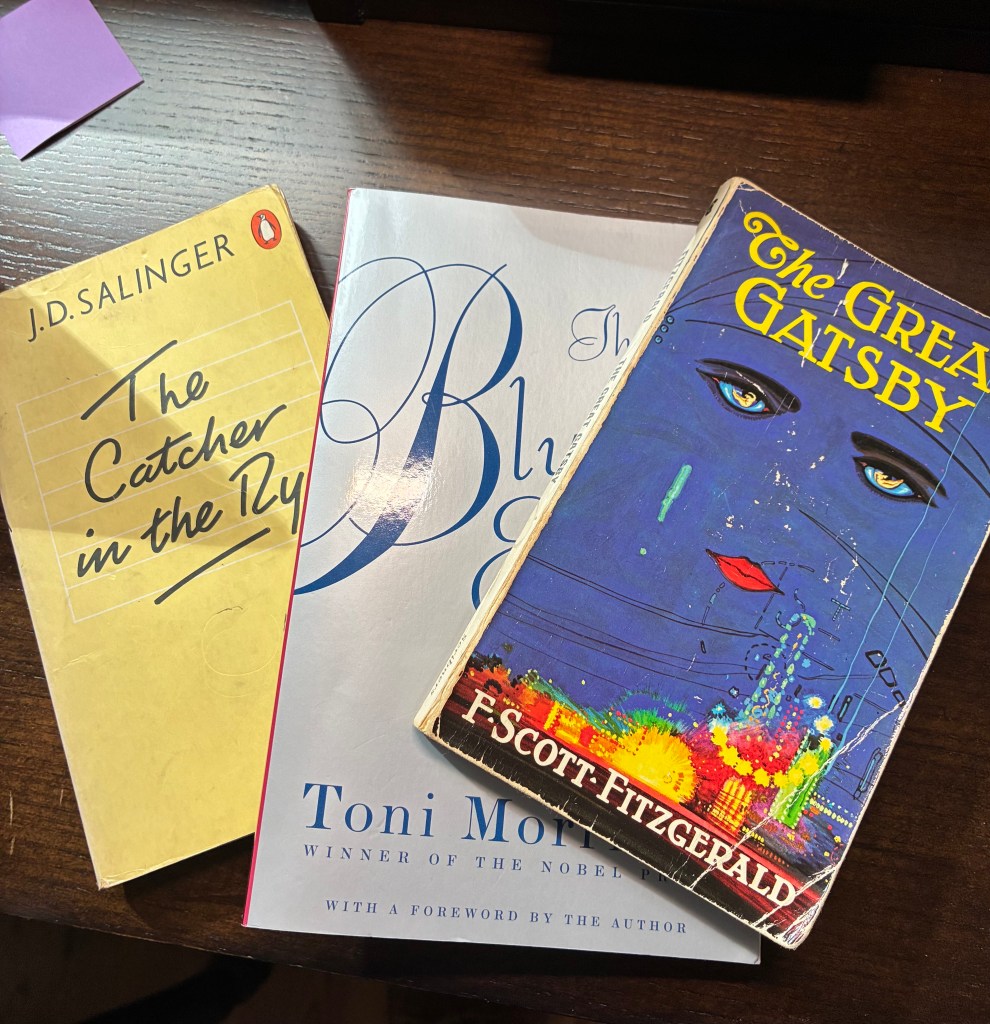
A good friend and fellow writer asked me (and others) for a list of my three favorite books. Since I primarily read and write fiction, and taught American Lit for many years, the three at the top of my list are all American literary classics. And since I’m an old guy, my picks skew toward 20th century authors. Which is not to say, that there aren’t many brilliant contemporary works, but turns out when asked to choose, I fall back on those books that stunned me as a young reader.
After considerable thought and poring through my bookcases, my first pick is The Catcher in the Rye, published in 1951 by the reclusive J.D. Salinger. This was one of the first books (maybe the very first) that made me want to be a writer. It’s probably best read and appreciated as a young person, especially one having a hard time figuring out what’s real and what’s not in a confusing world. The narrator of the novel, a prep school kid named Holden Caulfield, is obsessed with who is and who isn’t a “phony.” He’s a sensitive guy, and a bit annoying. He doesn’t play well with others and is constantly running afoul of his fellow students and teachers. He loves only his younger sister Phoebe. For a long time after first reading “Catcher” my own writing sounded suspiciously like Salinger’s. I did mostly get over that, though the writing tone is still in my head and my stories. When I re-read the book recently, I no longer felt the same pangs of loneliness and alienation I did when I read it in my teens, but I was still absorbed in the angst and terror of Holden’s voyage.
A very different, but no less brilliant novel, is my second choice: The Great Gatsby by F. Scott Fitzgerald, published in 1925. Again, this is a book that had a great influence on me as a writer. (Important to note: I, in no way, am comparing myself to these writers. Different ballparks entirely.) “Gatsby” is a period piece, a portrait of the Jazz Age of the 1920’s. And a portrait of the lives of some of the newly wealthy Americans of that time—people like Gatsby and his wife Daisy, who live lives of hidden desperation despite their gaudy life-style and dazzling parties. They are the precursors of our time period’s billionaire bro’s—reckless and lawless with their privilege, never having enough. But that’s not why I was entranced with the novel. The hero in my reading was the narrator and observer of the action, Nick Carraway, a young man who lives among the rich but is not of them. He provides the window for the reader—and not an unkind one. Nick is still impressionable. And comes of age and understanding through the action and climax of the story. Gatsby, himself, is the focus of the plot, but not truly the main character. I imagine Fitzgerald saw himself in the Nick character. This classic is worth a re-reading. (Many books are.) Fitzgerald said of the writing that he intended The Great Gatsby to be a serious literary achievement. He succeeded. Unfortunately, the rest of his life and writing career did not go as well.
A somewhat more contemporary novel is my third choice: Toni Morrison’s The Bluest Eye, first published in 1970. Morrison was awarded the Nobel Prize in Literature in 1993 for her entire body of work. This book, along with the work of James Baldwin, Richard Wright, and others; opened my eyes both to the African-American experience and to the brilliant writing that can come out of extreme oppression. The novel chronicles the life and experiences of a young black woman in the South who tries to make sense of her existence and of the burden of having a black skin in a white world—a world where even those of her own race judge others by the lightness or darkness of their skin. So encumbered is she by the mores and values of the white world, that the greatest dream of the narrator, Pecola Breedlove, is to have blue eyes. The book is beautifully written—lyrical, yet brutal, a powerful combination. Unlike the other two books, The Bluest Eye, was not a particular influence on my writing, mostly because I couldn’t imagine myself in the same circumstances as the characters therein, but also because I could never write so beautifully.
Those are my top three. What are yours?
 Butchblog
Leave a comment